
The Contractor will repay the advance payment not yet covered by the work completed, whilst construction continues uninterrupted in the areas not affected by the suspension.
An agreement has been reached between Duna Aszfalt Zrt. and KBM: the parties have decided to amend the works contract for the ‘Construction of the Mohács Danube Bridge and associated road network’ project. Under the amendment, monthly settlement will be reinstated in place of the previous annual milestone-based settlement. The agreement also addresses the status of the advance payment held by Duna Aszfalt that has not yet been offset against work performed.
Under the new settlement arrangements, monthly performance certificates and partial invoices will be directly linked to the work carried out during the given period. The advance payment may amount to 20 per cent of the outstanding contractor’s fee, in line with the original contractual structure.
The parties have settled their accounts with each other up to and including June the 22nd 2026, and Duna Aszfalt Zrt. has signed the contract amendment.
Under the new agreement, the advance payment amounts to 20 per cent of the outstanding contractor’s fee, i.e. 45 billion forints net. The Contractor shall repay the remaining 58.6 billion forints to the Client. Based on the technical schedule, the value of the works to be carried out in the coming period – expected to take place within three months – will exceed the amount of the advance payment repaid, which the Contractor shall submit to the Client on the basis of monthly statements of account.
Duna Aszfalt Zrt. undertakes to reduce the instalments payable on the basis of performance certificates and partial invoices by a proportion greater than the advance payment, for as long as the amount of the unaccounted-for advance allows. This solution provides the Client with further financial flexibility.
Milestone-based settlement and the increase in the advance payment were initiated by the previous administration. On the other hand, Duna Aszfalt Zrt. was open to jointly reviewing and renegotiating the settlement terms with the new Client, the Ministry of Transport and Investment.
The parties have separated the legal and financial issues, which can be resolved more quickly, from the more detailed technical discussions, which require more time. As a result, an agreement was reached within a short time on the settlement system and the advance payment, whilst negotiations on the future technical scope of the project are continuing.
“The negotiations are taking place in a constructive atmosphere on both sides. Duna Aszfalt Zrt. has not shied away from discussing any substantive issues: we are working in full cooperation and thinking together to find solutions that are sound from a professional, engineering and financial perspective. “It was a particularly forward-looking decision on the part of the Client to separate the legal and financial issues, which can be resolved more quickly, from the technical aspects requiring more lengthy consultation. This has significantly accelerated the negotiation process,” said Attila Kerékgyártó, Chairman of the Board of Duna Aszfalt Zrt.
Further negotiations will focus on agreeing the technical details of the project, including the 2x2-lane section that forms part of it. The aim is to return as fully as possible to the originally planned technical specifications and to draw up a scope of works that is clear, feasible and will adequately serve the region’s transport needs in the long term.
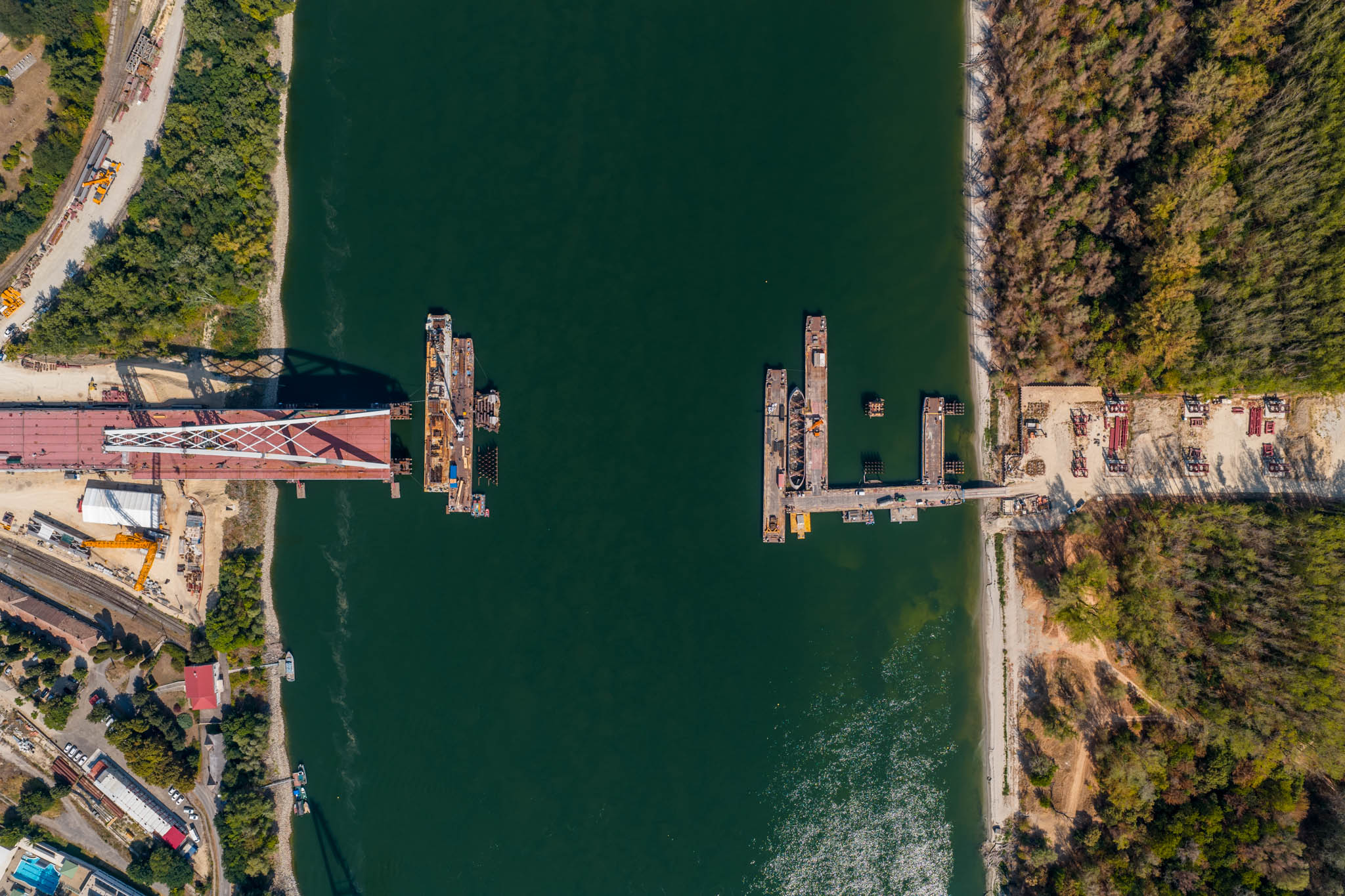
As part of the Mohács Danube Bridge and associated road network project, a new bridge 756 metres long comprising three bridge spans, approximately 28 kilometres of public roads, as well as additional bridges and smaller engineering structures are being built. By connecting the M6 motorway and the 51 main road, the development will establish a permanent road link between the two banks of the Danube, improve the region’s accessibility, boost the economy, and lay the foundations for a new, southern, east–west trade corridor.
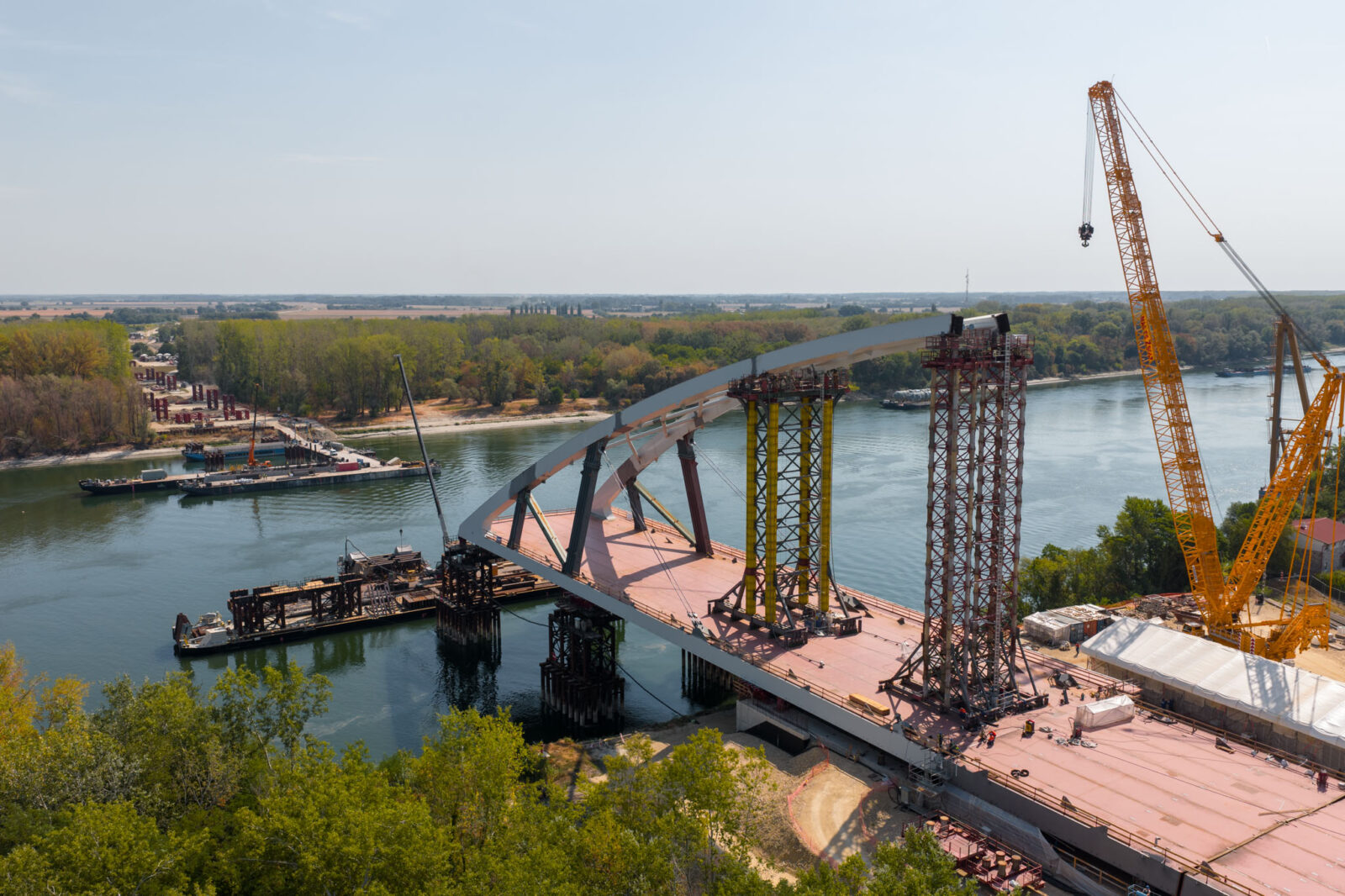
In the areas of the worksite not affected by the suspension, construction is proceeding continuously and at a good pace. On the Mohács side, the riverbed bridge section – weighing some 2,700 tonnes and containing approximately 700 tonnes of steel – has been advanced by 107 metres, meaning the massive structure is now travelling across the Danube towards its final position. Meanwhile, behind the bridge, preparations are already underway for the bridge elements of the next push section.
Significant progress has also been made on the Újmohács side: the first 60-metre advance of the B2 floodplain bridge has been successfully completed, and the pre-assembly of the bridge’s arch and deck elements, as well as the preparation of the auxiliary structures required for the pushing and assembly, is ongoing. The six shell elements forming the base of the riverbed pier have been completed, four of which have already been lowered into the Danube riverbed. Work is currently underway on the steelwork for the riverbed pier, seven metres below the Danube’s average water level.
An important milestone in the construction of the road network connected to the bridge was the opening to traffic, in early June 2026 on the Mohács side, of the four-lane section of road between the Busó roundabout and the M6 motorway. Work on the connecting section is also progressing according to schedule: between the Busó roundabout and the riverbed bridge, construction of the main carriageway embankment and a further three bridges is currently underway, whilst the replacement of utility lines is already 90 per cent complete.
With the closure of Ipari Road, construction of the cycle underpass next to the Incubator House has begun, and the beam work on the B05 bridge over the road has also been completed.
On the Great Plain side, the assembly area for the floodplain bridge has been completed, and preparatory work for road construction has been finalised along the entire section. Subsequently, work began on the embankment foundations, part of which has already been completed.
The work being carried out in parallel on both banks clearly demonstrates that construction is progressing rapidly in the active areas of the project, and Duna Aszfalt Zrt. is doing everything in its power to ensure the project continues to advance successfully.
Further press information: sajto@dunaaszfalt.hu
The construction of the Mohács Danube Bridge and associated road network is one of Hungary’s largest ongoing transport development projects. As part of this, a new Danube bridge comprising three bridge spans totalling 756 metres in length, approximately 28 kilometres of new public roads, as well as additional bridges and smaller engineering structures are being built. By connecting the M6 motorway and the 51 main road, a new, permanent link is being established between the two banks of the Danube and the national expressway network.
Construction began in September 2024, and more than 1,500 people have been involved in the various stages of the project to date. The project is not only building roads and bridges, but also boosting the economy: it provides jobs, strengthens local businesses, improves the region’s accessibility, and can pave the way for further investment.
The Mohács Danube Bridge is a key element of a long-overdue south-east–west transport corridor, strengthening the Pécs–Mohács–Baja–Szeged link. Its significance, however, extends far beyond the region: through the Hercegszántó border crossing and the approximately 186-kilometre-long expressway being built in Serbia under the name ‘The Smile of Vojvodina’, it could, in the longer term, become part of a new international transport corridor between the Balkans and Western Europe.
The Duna Group is one of Central and Eastern Europe’s leading construction groups, with Duna Aszfalt Zrt. as its flagship company. The group has been carrying out complex transport and infrastructure development projects for more than three decades and employs over 3,500 staff in Hungary and through its international subsidiaries. In addition to Hungary, the group is present in several other European countries and is playing an increasingly significant role in the implementation of international project development and concession projects. Its activities range from project development and financing, through design, construction and the application of digital engineering solutions, to long-term operation and maintenance.