
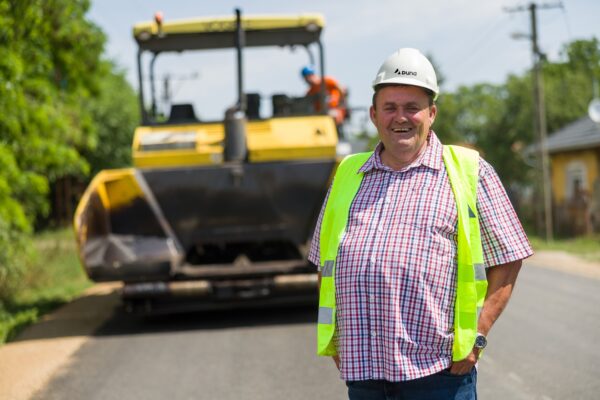
László Varga, site manager at Duna Aszfalt Zrt., is one of those seasoned professionals for whom road construction is first and foremost about the job site, organization, and teamwork. Throughout his career, he has worked on municipal projects, public roads, and expressway sections, but he considers the M44 and M4 projects to be his most notable works. Currently, his responsibility is to coordinate and harmonize 10 public road renovation projects spanning approximately 50 km across four counties.
László Varga has been working in the road construction industry for nearly five decades. “I started my career laying kerbstones,” he says when we ask him about the beginning of his career. He later moved from Magyar Aszfalt to Vakond Kft., and then continued working at Duna Aszfalt Zrt., where he has been employed ever since.
His first major assignment with our group of companies was the Törökszentmiklós bypass section of Highway 4 in 2002–2003. The second major project involved work related to the Mercedes plant in Kecskemét.
One of the most significant turning points in his career was the M44 project. This was a flagship project not only because of its size, but also because it required simultaneously managing a large work site, numerous machines, material supply, deadlines, technical inspections, and various specialized disciplines. On a project of this scale, the construction manager’s role is no longer merely to ensure that individual work processes run smoothly, but to ensure that the entire system functions effectively.
For László Varga, the M44 project was also pivotal because it was here that the kind of coordinated construction approach—which he later carried forward in the M4 projects—truly became part of his daily routine. In expressway construction, you need to know in advance who is working where, what each work process depends on, when each layer will be completed, and what measurements must be taken before moving forward.
“I think there’s a big problem if a construction manager doesn’t know what he’ll be doing in the coming week,” he says. This statement reveals a lot about how he thinks about the profession.
Even the best-planned schedule for a major construction project is constantly changing. Weather, material supply, traffic conditions, and unexpected technical problems all affect construction. According to László Varga, there was a period in the winter of 2024–2025 when the project was roughly one and a half months behind schedule.
They eventually managed to make up for the delay through organized, coordinated work. Favourable spring and summer weather also played a role, but weather alone cannot accomplish a task of this magnitude. It required precise planning, disciplined execution, and a well-functioning team.
Toward the end of the project, they also had to contend with another unexpected situation. About a month before handover, heavy rains caused slope failure along several kilometres. The damage had to be repaired in a way that wouldn’t jeopardize the handover schedule.
“We managed to do it in a month without affecting the handover,” he says. He is particularly proud of this because they not only had to work quickly but also in accordance with regulations, to certified standards, and with everything technically sound.
There were greenfield sections where construction proceeded along a new track, and there were bypass sections where a new lane had to be built alongside the existing two-lane road, followed by the renovation of the old lane. All of this had to be done while maintaining traffic flow on Main Road 4. Traffic had to be dislocated from one side to the other via temporary detours while construction proceeded continuously. This became even more complex at the interchanges, as traffic and construction work had to be safely managed simultaneously at those locations.
The project included 14 engineering structures, grade-separated interchanges, rest areas, drainage systems, culverts, bridges, and wildlife crossings. “Everything you’d find in civil engineering was here,” he summarizes.
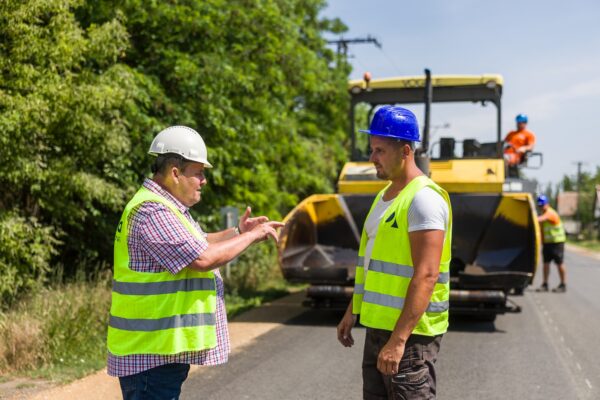
When asked what he’s most proud of, László Varga doesn’t point out himself first, but rather the team: the machine operators, the drivers, the technical staff, and the colleagues working in project management and documentation.
“Everyone contributed their expertise,” he says. In his view, a major project only works if people aren’t just trying to complete their own part tasks in isolation, but if everyone understands how their work connects to that of others. If someone does some earthwork today, that might lead to asphalt paving next week. If a waterworks task isn’t completed on time, it could later hold up an entire phase of the project. That’s why he considers thinking ahead to be crucial.
László Varga describes himself as an old-school guy. There’s nothing nostalgic or self-pitying about this. Rather, it means that for him, professional independence, responsibility, and experience gained in the field remain core values to this day.
At Duna Aszfalt, he appreciates that he’s been given this autonomy. “I was given free hand to work; they didn’t tell us how to do things,” he says. He adds that he always received help when he needed it, but managing construction remained his responsibility.
In his view, this is one of the reasons why it’s great to work at Duna Aszfalt. Anyone who is professionally qualified and wants to apply their knowledge to their work can thrive here. In addition, large projects foster a unique sense of community.
“On a project this big, people practically become friends,” he says.
For him, this “family-like atmosphere” isn’t just an empty phrase—it’s part of their day-to-day collaboration. On a major project, the same people often work side by side for months or even years on end. You have to find common ground with colleagues, subcontractors, the technical team, and project management.
László Varga is planning to retire in two years, but when he talks about his work, he doesn’t view his career as a closed chapter. Rather, he sees it as a long professional journey, every stage of which has contributed to the way he thinks today as a construction site manager.
From curbing and pothole repairs to municipal projects, and on to the M44 and M4 highways, the same approach guides him throughout: the work must be organized, problems must be solved, and the team must be kept together.
This is the kind of knowledge you can’t just learn from a book. It takes years, a lot of hard work, decisions, mistakes, corrections, and successful project takingovers.