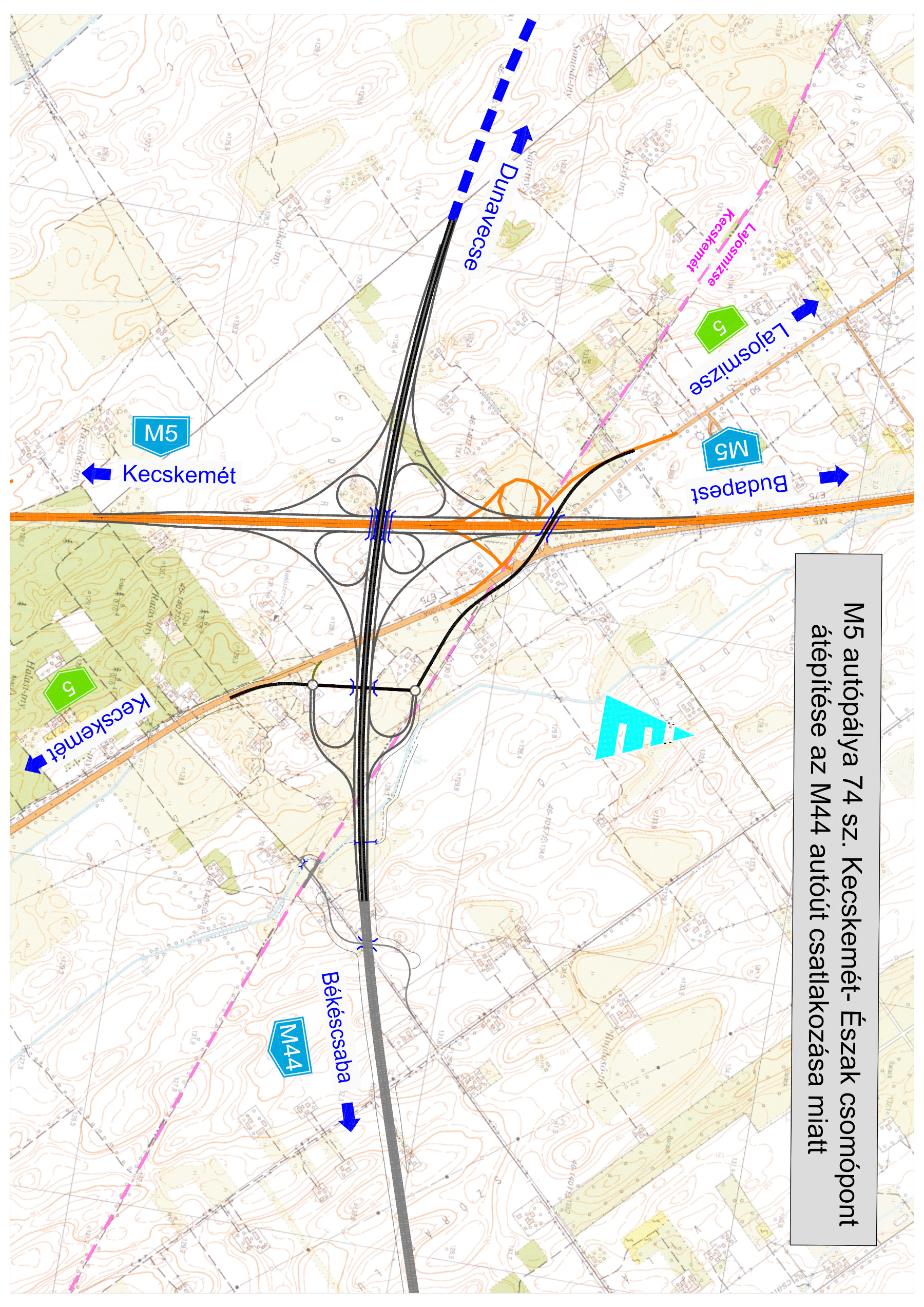
In February 2025, Duna Group member Hódút Építő Kft. signed a contract amendment to build the interchange between the M5–M8 (future M200) motorway and the M44 expressway. This interchange will connect the already under-construction of the 32 km-long Kecskemét–Szentkirály section of the M44 to the M5 motorway, becoming the largest rural road interchange in Hungary.
Since April 2025, the 32.2 km section of the M44 between Kecskemét and Szentkirály has been in use, providing a four-lane connection between Békéscsaba and the M5 motorway.
The entire interchange is expected to be completed by the end of 2026, significantly improving the road connection between Eastern and Western Hungary. Although recurrent traffic restrictions will be necessary during construction, the result will be a modern junction of international standard that strengthens Hungary’s long-term logistical competitiveness.
The scale of the project is shown by the construction of 22.3 kilometres of road with three-layer asphalt pavement and Ckt base course. The development includes the completion of 7 new engineering structures, and the demolition of one existing overpass. The attached drawing shows the above-mentioned elements — at first glance, this project certainly does not seem to be such a large-scale undertaking.
A correction section has also been built on Main Road 5, including two roundabouts, ensuring the connection between the M44 expressway and Main Road 5. This was a condition for the completion of the Kecskemét–Szentkirály section, which was opened in mid-April.
The new engineering structures over the M5 motorway are being built without intermediate supports in the main carriageway cross-section. The overpass to be demolished can only be removed once the Partial Technical Handover for the newly built overpass (along the location line of Main Road 5) instead of it has happened and it has been granted temporary traffic approval. During the construction of the interchange, multiple phased technical handovers and traffic diversions will take place to ensure continuous road traffic flow.
The project is being carried out under the investment of the Ministry of Construction and Transport. The uniqueness and the complexity of the construction process are well demonstrated by the fact that the organisations involved in building the interchange—MKIF (Hungarian Concession Infrastructure Development Plc), AKA (AKA Alföld Concession Company Ltd.), Magyar Közút (Hungarian Public Roads) and the competent permitting authorities—have never worked together in this configuration on a single project before.
The full cloverleaf design of the interchange is exceptional not only in size but also in engineering prestige in Hungary. There is currently only one other interchange of this geometry in operation in Hungary, making the Kecskemét project another milestone in the history of national infrastructure development.
For Duna Group, this task is not only a professional challenge but also a renewed demonstration of our commitment to developing Hungary’s transport infrastructure besides strengthening the country’s economic competitiveness.