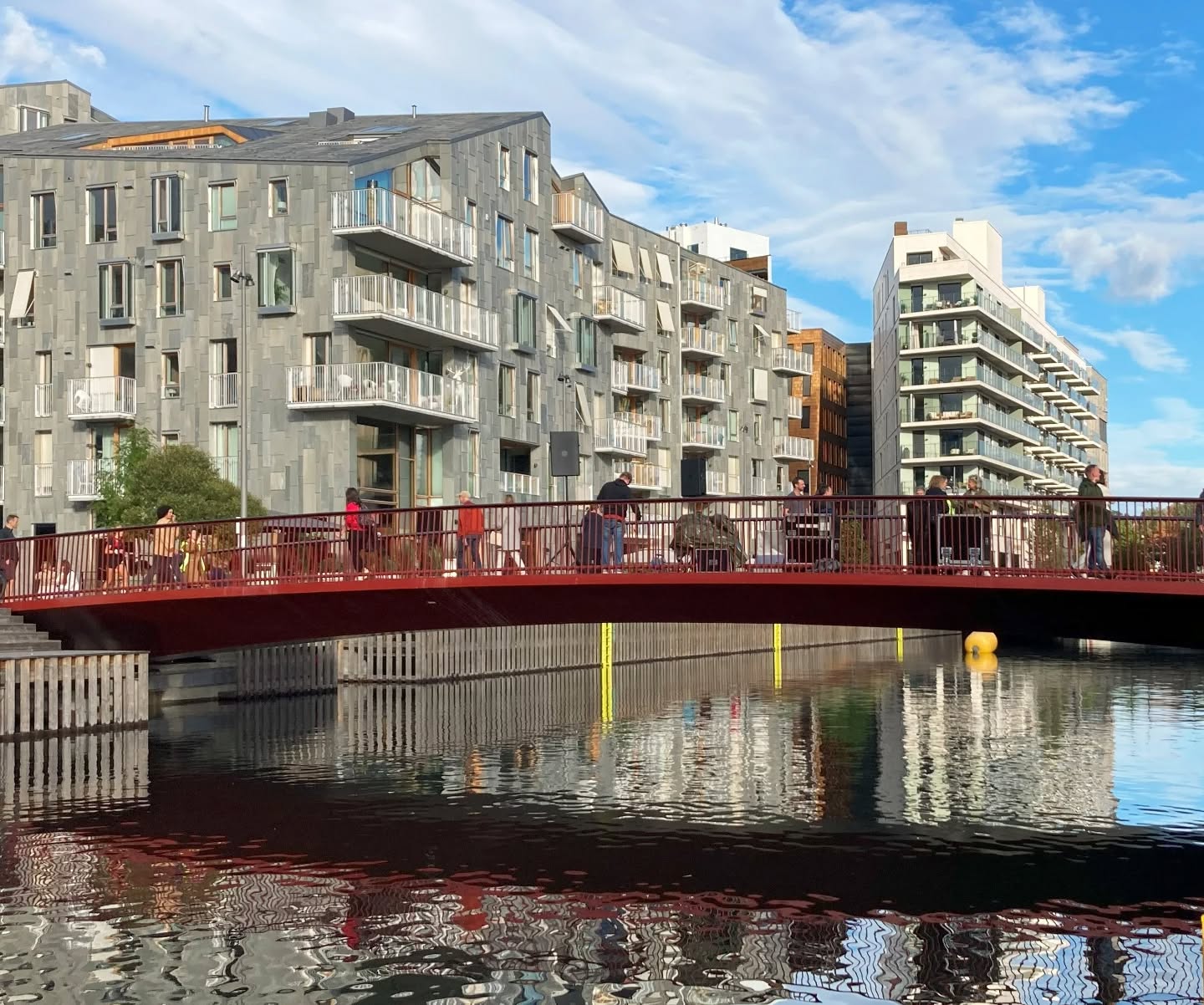
The execution of the Grunningen pedestrian bridge clearly demonstrates the Duna Group’s ability to deliver consistent quality and innovative engineering solutions while meeting the differing technical, environmental and regulatory requirements of multiple countries. The pedestrian and cycle bridge, constructed in the city centre of the Norwegian capital, was realised with the key involvement of WKS Duna Polska, the Duna Group’s manufacturing subsidiary in Poland. From design through fabrication to on-site installation, the project was delivered as a high value-added, export-oriented undertaking.
The uniquely shaped steel structure, weighing nearly 60 tonnes, was fabricated as a single unit at the Będzin plant and, following approximately 1,500 kilometres of combined land and sea transport, arrived in Oslo. The complexity of the project – ranging from non-standard fabrication solutions and compliance with strict Norwegian corrosion protection requirements to specialised logistics and lifting operations – clearly reflects the Duna Group’s international engineering expertise and integrated project management approach.
The Grunningen pedestrian bridge is a combined pedestrian and cycle bridge connecting the northern and southern parts of the Vannkunsten district in central Oslo. The steel bridge structure was constructed in one piece as a single transported element, weighing nearly 60 tonnes and measuring 28 metres in length, 6.5 metres in width and 2 metres in height. The completed bridge structure travelled approximately 1,500 km by land and sea from the WKS Duna Polska plant in Będzin to the Norwegian capital.
The construction of the pedestrian bridge required precise engineering, detailed technological preparation and the implementation of numerous non-standard solutions. These arose from the structure’s unique character, complex geometry, Norwegian corrosion protection regulations and transportation constraints.
One of the first challenges for the WKS Duna Polska team was the accurate fabrication and fitting of the individual components and structural elements, particularly due to their curved, arched and drop-shaped forms. Cutting the components from the base material and designing allowances for welding shrinkage required a high degree of precision. During fabrication, numerous templates were used by experts to ensure that the correct geometry of the structure was maintained. The bridge features a closed steel box girder with a curved deck plate, a curved bottom flange with variable radius and width, and a slender inclined web integrated with these elements.
A specific design solution involved the use of 50 mm thermal insulation beneath the orthotropic deck plate (floor slab). Its purpose is to increase the efficiency of the electric heating system installed in the deck, which is intended to prevent icing of the pedestrian bridge.
Due to the dimensions of the finished element and the stringent requirements of Norwegian technical specifications, the corrosion protection process was more complex than under Central European standards. Following abrasive blasting, the primer layer was applied by metal spraying. The application of the corrosion protection coating layers was carried out with increased attention and continuous technical supervision. The entire structure was ultimately finished with a superb red coating in RAL 3009.
The project also included the steel guard rails. To harmonise with the bridge’s curved geometry, the vertical rail bars were designed in a wave-like pattern, resulting in virtually no two identical elements. The outcome is a distinctive visual appearance that integrates well with the form of the bridge. The rails were hot-dip galvanised and subsequently protected with a powder-coated finish.
During transportation to the site, the 60-tonne element, supported at two points spaced 27 metres apart, required special support structures as well. These were fabricated from beams measuring 250 × 200 mm, each 3 metres in length, and were designed to significantly reduce concentrated loads and distribute them evenly across both the axles of the transport trailer and the deck of the vessel.
Despite the numerous technological and logistical challenges, the Grunningen pedestrian bridge successfully arrived on site from the Polish manufacturing plant, where a 400-tonne floating crane lifted it into its final position in a single operation. Bravo.